How much does custom ceramic art cost?
It’s the question almost every commission inquiry circles around, and the one artists answer least directly. So let me be direct: there is no price list for custom work — and that isn’t evasion. It’s the honest consequence of how these pieces are made. Every commission is built by hand, from scratch, for one specific room and one specific person, and the price is shaped by the same forces that shape the piece itself.
But “it depends” is not a useful answer on its own. Here is what it depends on — and the real numbers that will help you know what to expect before you write to me.
Where do prices begin?
The clearest anchor is my available work, since commissions are priced in the same language:
Tabletop vessels and vases generally range from $330 to $800, with larger and more complex vessels reaching $1,200–1,500.
Freestanding sculptures range from $1,800 to $4,500 and beyond, depending on scale and form.
Wall sculptures begin around $340 for single pieces, with multi-piece compositions priced by scope.
Large wall installations and coordinated series — works composed of many hand-built elements, or families of related pieces across a space — are scoped individually, and the conversation usually starts in the low four figures.
A commission typically lands near what a comparable piece would cost in the shop, adjusted for the factors below. If you want a feel for the range, browse the available work — the prices there are the truest guide I can offer.
What makes one piece $500 and another $4,500?
Four things, mostly. They’re worth understanding, because they’re also what you’re actually paying for.
Size — but not the way you’d think
A larger piece takes more clay and more hours, but the cost doesn’t rise in a straight line — it rises with risk. A large hand-built form has to be constructed in stages, dried over weeks with great patience, and fired knowing that the bigger the piece, the more the kiln can take away. Scale multiplies both the labor and the stakes, and the price reflects both.
Complexity of form
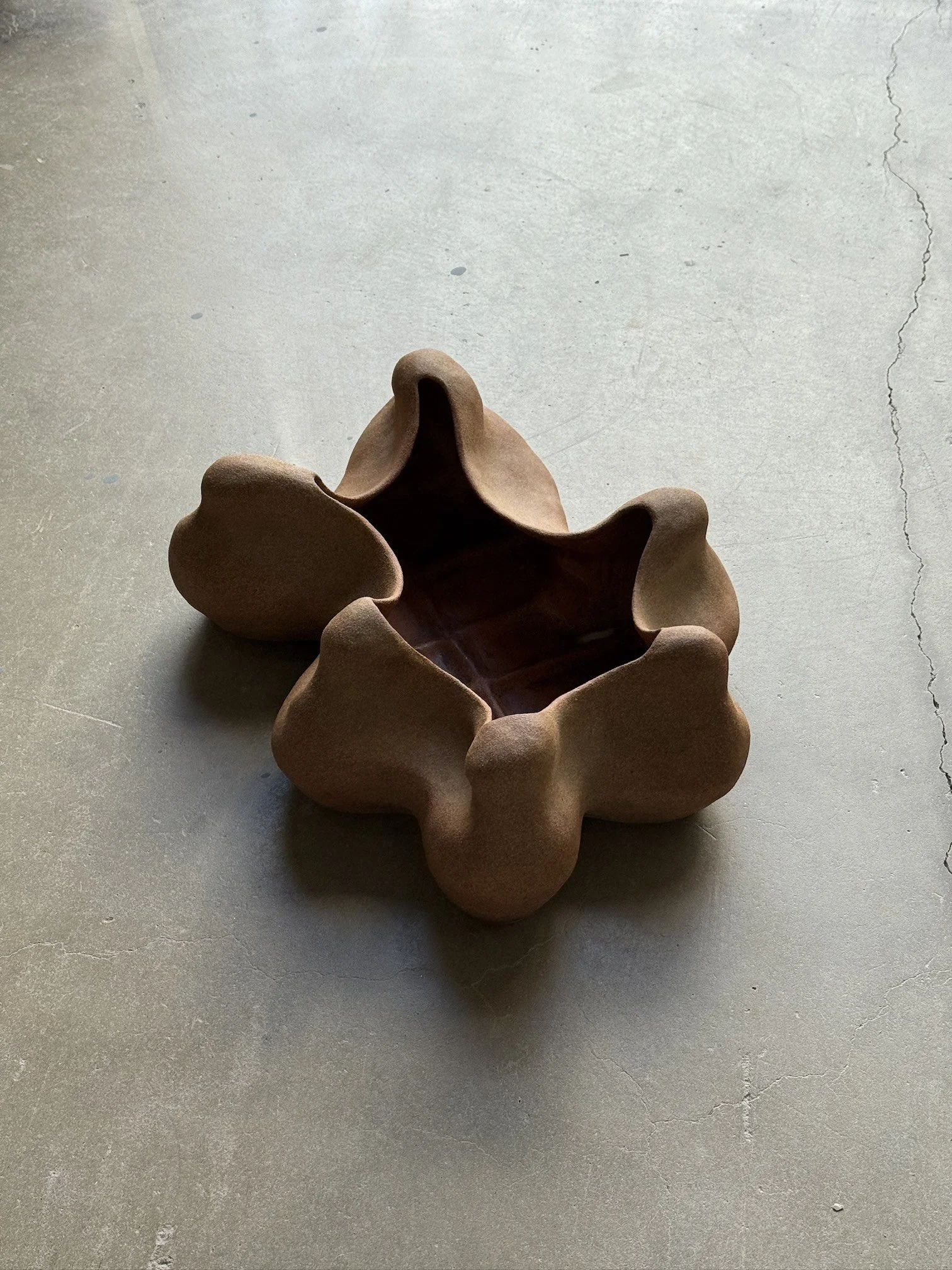
A composed, symmetrical vessel and a form that leans, folds, or seems to move mid-gesture are entirely different undertakings. Cantilevered curves need internal support while building. Fluid silhouettes are shaped slowly, coil by coil, over many sessions. Mixed-media elements — like the wire work in some of my vessels — add another discipline entirely. The more a piece defies what clay wants to do on its own, the more time it asks of me.
Materials and firing
Surfaces carry real cost differences. A raku firing is its own event — unpredictable, physical, and occasionally heartbreaking. Lava and textured glazes require test firings and layered applications. Some pieces go through the kiln twice; some, more. A bare clay surface, which I love most, demands flawless construction, because there is no glaze to forgive what the hand left behind.
One of a kind — made twice
Every commission is singular, and singularity has a particular cost structure: there is no economy of repetition, no mold to amortize. And because handmade work develops its own character in the making, I typically build two versions of each commissioned piece, so you can choose the one that resonates most. You receive one piece; the studio makes two. That is part of the price — and, I’d argue, the best part of the process.
Why don’t I publish a fixed price list?
Because it would either overcharge you or undersell the work. A fixed list has to assume the most complex case or the simplest one. Pricing each commission individually means you pay for what your piece actually requires — nothing more. It also means the first step costs nothing: you describe what you’re imagining, and I come back to you with a real number for that specific piece, usually within a few days.
How does trade pricing work?
Interior designers, architects, art consultants, and hospitality teams work with the studio under trade terms — details are on the For Interior Designers and For Hospitality pages. Coordinated multi-piece commissions for larger projects are quoted as a single scope, and for hospitality timelines, the earlier the conversation starts, the more the budget can do.
How to get an accurate quote
When you start a commission inquiry, three details let me give you a real number instead of a range:
Scale and placement — the size you’re imagining, and where the piece will live.
References — pieces of mine that resonate, or images of the space.
Your budget range — not to spend it all, but to design to it. A budget is a design constraint like any other, and I can usually tell you honestly what’s possible within it — and where the next threshold opens up.
Most commissions take four to twelve weeks; larger installations, several months. More on the full process is in my guide to commissioning custom ceramic art, and shorter answers live on the FAQ.
The price of a custom piece is, in the end, the price of weeks of one person’s hands on one object that will exist exactly once — twice, briefly, until you choose. If you’re wondering whether what you’re imagining is within reach, the answer is usually closer than you’d expect. Tell me what you have in mind →